Stories · June 15, 2024 · 5 min read
The Ancient Art of Kerala Spice Farming
Deep in the Western Ghats, where the mist rolls in before sunrise and clings to the cardamom vines until mid-morning, the farming families of Idukki have been practising the same cultivation methods for generations. There are no vast monoculture fields here. A Kerala spice garden looks, at first glance, like untouched rainforest — and that is exactly the point.
Farming inside the forest, not instead of it
Cardamom grows in the dappled shade of native canopy trees. Pepper vines climb jackfruit and silver oak rather than concrete posts. Turmeric and ginger fill the understorey, while nutmeg and clove trees stand where the light breaks through. This layered system keeps the soil cool and alive, holds the monsoon rain, and gives each spice the slow, stressed, flavour-concentrating growth that plantation shortcuts can never replicate.
Everything by hand, everything in season
Cardamom capsules are picked one by one, only when three-quarters ripe — too early and the oils are thin, too late and the pods split. Pepper is harvested spike by spike as it turns from deep green to the first blush of yellow. Nothing is stripped from the plant by machine, because a machine cannot tell the difference. The farmers can, by touch, before they can even see it.
"My grandmother judged cardamom by rolling it between her palms and listening. I still do the same." — a third-generation grower in Udumbanchola
Why it matters in your kitchen
Spices grown this way carry dramatically more essential oil — the volatile compounds responsible for aroma and heat. When we say farm-direct, we mean this: the pod that was on the vine last week, dried gently and packed within 72 hours, not a warehouse lot blended for uniformity. Once you cook with it, the difference is not subtle. It is the whole point.
Shop single-origin spices →
Wellness · June 10, 2024 · 4 min read
Five Spices Every Kitchen Needs
You do not need forty jars to cook well. You need five — chosen well, stored well, and replaced before they fade. Here is the honest short list we would give a friend setting up a kitchen from scratch.
1. Black pepper (whole)
Buy it whole, always. Freshly cracked Kerala pepper is floral and hot at once; pre-ground pepper is mostly dust and regret. Beyond seasoning, piperine — pepper's active compound — helps your body absorb nutrients from other foods, including turmeric's curcumin.
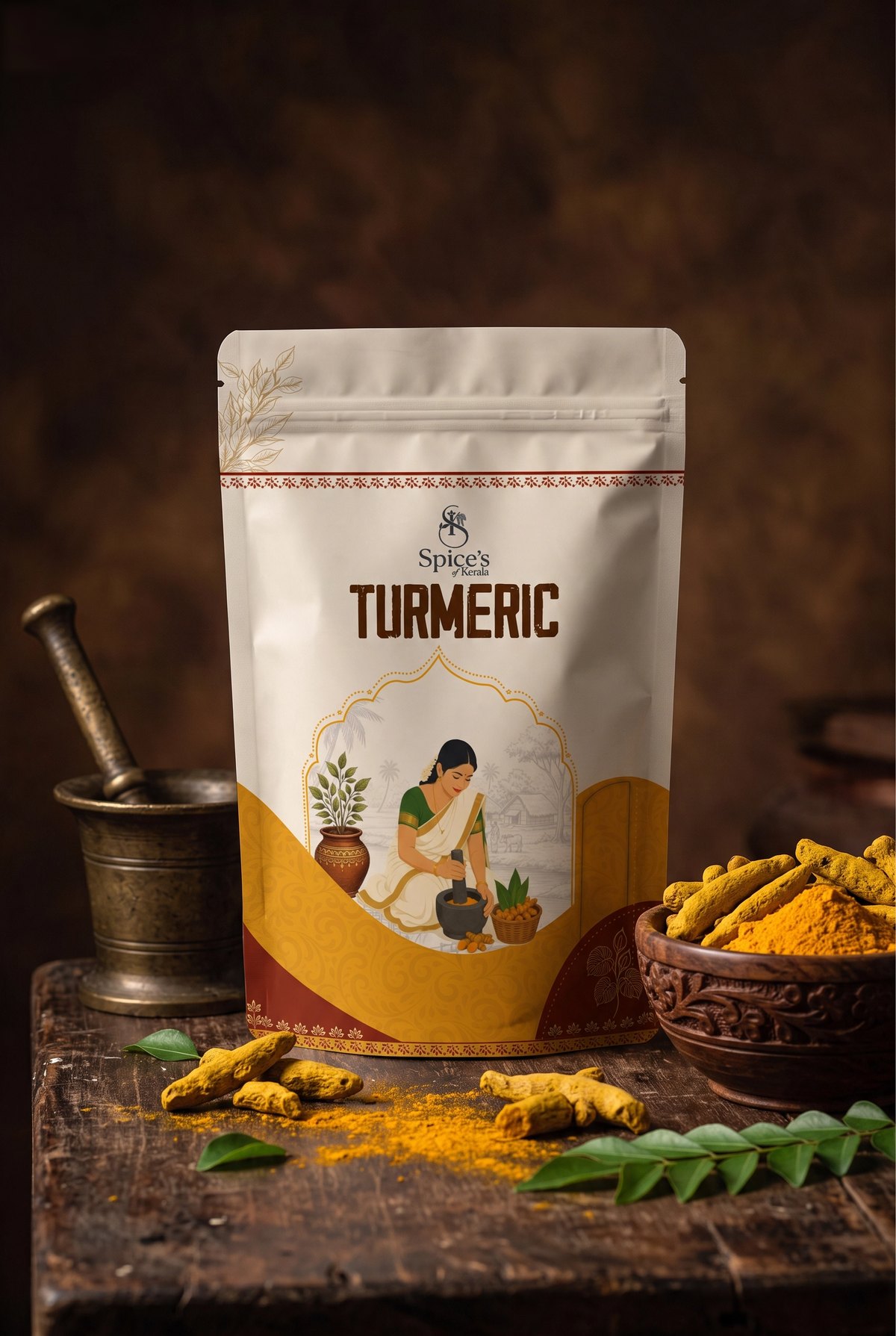
2. Turmeric
The backbone of everyday Indian cooking and a gentle anti-inflammatory ally. A quarter teaspoon in dals, rice, scrambled eggs, or warm milk adds colour, earthiness, and quiet benefit. Look for deep orange colour — a sign of high curcumin content.
3. Green cardamom
Crush two pods into your morning chai or coffee and you will understand why traders once crossed oceans for it. It lifts rice dishes, desserts, and stews. Whole pods keep their magic for a year; ground cardamom fades in weeks.
4. Cloves
Tiny, potent, and easy to overuse — which is part of the fun of learning them. Two or three cloves round out biryanis, braises, stocks, and mulled drinks with warm depth.
5. Cinnamon (true or cassia)
Sweet dishes are the obvious home, but try a small piece in tomato-based curries and slow-cooked meats. It adds a roundness you will miss when it is gone.
Storage rule of thumb: whole spices, airtight jar, dark cupboard — never above the stove.
Start with these five, buy small quantities more often, and your everyday cooking will change before your spice rack does.
Build your starter shelf →
Stories · June 5, 2024 · 4 min read
From Monsoon to Market: A Pepper's Journey
Every peppercorn in your grinder began its life waiting for rain. When the southwest monsoon breaks over the Western Ghats in June, the pepper vines — draped over jackfruit and silver oak trees across Idukki and Wayanad — burst into slender flowering spikes. No rain, no flowers. No flowers, no pepper. The whole crop is a conversation with the sky.
Eight months on the vine
From flowering to harvest takes the better part of a year. The berries swell slowly through the wet months and mature in the cool, dry weeks of December to February. Pickers judge readiness by colour: when one or two berries on a spike blush yellow-orange, the spike is ready. Climbing bamboo ladders, they harvest by hand, spike by spike — a single vine can take an entire morning.
The three-day transformation
Fresh green pepper becomes black pepper through nothing more than sunshine. The berries are briefly blanched, then spread on woven mats in the courtyard sun for three to five days. As they dry, the skin darkens and wrinkles into the familiar corrugated shell, concentrating piperine and volatile oils. Turned by hand several times a day, guarded from unexpected rain, the crop slowly gives up its water and gains its fire.
A good harvest smells like the whole courtyard is cooking — sharp, green, and sweet all at once.
Sorted, not blended
Here is where our path leaves the commodity road. Bulk pepper is pooled across hundreds of farms and blended to an average. Ours is sorted by density and size at origin, packed within days, and shipped as the produce of a single hillside. When you crack one of these peppercorns, you are tasting one farm, one monsoon, one family's patience.
Taste single-origin pepper →
Recipes · May 28, 2024 · 6 min read
Kerala Fish Curry with Fresh Spices
This is the fish curry of the Kerala coast — sour with kudampuli (smoked kokum), fiery with chilli, and mellowed with coconut milk. It is a weeknight dish in Kerala homes, and once your spices are fresh, it can be one in yours too. Serves four.
You will need
- 500g firm fish (kingfish, seer, or salmon), cut into thick pieces
- 2–3 pieces kudampuli, soaked in warm water (or 1 tbsp tamarind paste)
- 2 tbsp coconut oil, 1 tsp brown mustard seeds, a sprig of curry leaves
- 1 sliced onion, 1 tbsp ginger-garlic paste, 2 slit green chillies
- 2 tsp Kashmiri chilli powder, 1 tsp coriander powder, ½ tsp turmeric, ½ tsp freshly cracked black pepper
- 400ml thin coconut milk + 100ml thick coconut milk, salt to taste
Method
- Heat the coconut oil in a clay pot or heavy pan. Pop the mustard seeds, then add curry leaves — let them crackle for five seconds.
- Soften the onion with the ginger-garlic paste and green chillies over medium heat, about 6 minutes.
- Lower the heat and add the chilli, coriander, turmeric, and pepper. Stir for 30 seconds — no longer, or the spices scorch.
- Pour in the thin coconut milk and the kudampuli with its soaking water. Simmer 5 minutes.
- Slide in the fish. Simmer gently, uncovered, 8–10 minutes. Do not stir — swirl the pan instead so the fish stays whole.
- Finish with the thick coconut milk, warm through without boiling, and rest 10 minutes before serving.
The rest is not optional — fish curry always tastes better after it has had time to think.
Serve with matta rice or plain steamed rice, and expect silence at the table.
Get the spices for this recipe →
Wellness · May 20, 2024 · 5 min read
The Health Benefits of Turmeric
Turmeric may be the most studied spice on earth, and also the most oversold. So let us be honest about what this golden root genuinely offers — because the truth is still impressive.
What the evidence supports
Curcumin, turmeric's signature compound, is a well-documented anti-inflammatory and antioxidant. Research links regular intake to support for joint comfort, digestion, and general cellular protection against oxidative stress. What turmeric is not: a cure-all, a detox miracle, or a replacement for medical care. It is a small, steady, daily ally — the way Kerala households have always treated it.
The absorption problem (and the ancient fix)
Curcumin on its own is poorly absorbed — most passes straight through you. Two things change that dramatically: black pepper and fat. Piperine, the active compound in pepper, can increase curcumin absorption many times over, and because curcumin is fat-soluble, taking it with coconut milk, ghee, or any cooking oil helps it reach your bloodstream. Notice that traditional cooking — turmeric bloomed in hot oil, alongside cracked pepper — solved this problem centuries before anyone isolated a molecule.
Old wisdom, new vocabulary: golden milk was doing "bioavailability" long before the word existed.
How to use it daily
- A quarter teaspoon in dals, soups, rice, and scrambled eggs
- Golden milk before bed — turmeric, pepper, and warm milk of any kind
- Bloomed in oil at the start of any curry, never dumped in at the end
Quality matters more with turmeric than almost any spice, because market-bought powder is notoriously adulterated. Ours is single-origin, lab-tested, and nothing but ground root — the colour comes from curcumin, not from anything you need to worry about.
Shop pure turmeric →
Gift Guide · May 15, 2024 · 4 min read
Gift Guide: Spice Boxes for Food Lovers
A good spice box is one of the few gifts that gets used every single day, and thought of every time it is. Here is how to match the box to the person — from the friend who just got their first kitchen to the cook who has everything.
For the new cook
Start them with the essentials: turmeric, whole black pepper, cardamom, cinnamon, and cloves. It is a complete foundation for everyday Indian cooking, and small jars mean everything stays fresh while they learn. Add a handwritten note about the golden milk ritual and you have given them a habit, not just a present.
For the chai lover
Cardamom, cinnamon, cloves, dry ginger, and good black tea. Everything needed for proper masala chai made from scratch — a gift that upgrades every single morning that follows. If they already make chai, they will taste the difference in the first cup.
For the serious home cook
Go single-origin and go whole: Idukki cardamom, Wayanad pepper, whole nutmeg with mace still attached, true cinnamon quills. Cooks who grind their own spices understand exactly what they are holding — and this is the tier where our farm-direct sourcing shows off.
For the person who has everything
A subscription. Fresh, small-batch spices arriving through the year means the gift keeps landing on their doorstep long after the occasion — and subscribers save 15% on every order, forever.
Spices are the rare luxury that is also a daily staple. That is what makes them such a satisfying thing to give.
Browse gift boxes →
Education · May 10, 2024 · 5 min read
Understanding Cardamom Grades
Not all cardamom is equal — not remotely. Two jars that look similar on a shelf can differ enormously in oil content, aroma, and honest value. Here is a plain-language guide to how cardamom is actually graded, so you know what you are paying for.
Size: the millimetres that matter
Cardamom is sifted through graded meshes, and bigger is genuinely better. Pods of 8mm and above — the "bold" grades — have more seeds and more essential oil per pod. Alleppey Green Bold (AGB) and Extra Bold (AGEB) sit at the top of the Indian grading system. Smaller pods are not fake, but they are lighter on the oils that make cardamom worth buying.
Colour: green means fresh
A deep, even green signals careful low-temperature curing soon after harvest. Pale, yellowish, or straw-coloured pods have been over-dried, sun-bleached, or simply stored too long. The green fades as the aroma does — which makes colour an honest, visible freshness indicator.
Density: the litre-weight test
Graders weigh a fixed volume of pods; heavier means denser seeds and higher oil content. You can run a home version of this test: a quality pod feels plump and slightly heavy between your fingers, and the seeds inside should be dark, sticky, and sharply fragrant — not grey and dusty.
Quick check at home: crush one pod. If the scent does not reach the far side of the kitchen, the grade does not matter — it is stale.
Our cardamom is 8mm+ bold grade from the Idukki hills, cured within days of picking and shipped whole, because ground cardamom loses its soul in weeks. Once you have cooked with the real grade, the shelf stuff becomes very hard to go back to.
Shop bold-grade cardamom →
Wellness · May 3, 2024 · 3 min read
The 5-Minute Golden Milk That Actually Works
Most golden milk recipes miss the two details that make turmeric actually work: black pepper and fat. Curcumin — the compound you are drinking this for — is poorly absorbed on its own. Piperine from freshly cracked pepper boosts its uptake dramatically, and because curcumin is fat-soluble, a little richness in the milk carries it where water cannot.
The recipe
- 1 cup milk (dairy or coconut — both carry fat, both work)
- ½ tsp pure turmeric powder
- 2–3 twists of freshly cracked black pepper
- 1 crushed cardamom pod or a pinch of cinnamon
- Honey or jaggery to taste, added off the heat
- Warm the milk gently in a small pan — do not boil it.
- Whisk in the turmeric, pepper, and cardamom.
- Hold it at a bare simmer for 3–4 minutes so the spices infuse.
- Take it off the heat, sweeten, and pour.
The pepper is not optional. Without it, you are mostly drinking pleasant yellow milk.
Drink it in the evening — it is naturally caffeine-free and makes a gentle end-of-day ritual. And use turmeric you trust: colour-enhanced market powder defeats the entire purpose. Ours is single-origin and nothing but root.
Get golden milk essentials →
Education · April 26, 2024 · 4 min read
Why Your Garam Masala Goes Flat (and How to Fix It)
You know the disappointment: a generous spoon of garam masala, and the curry tastes of... vaguely brown warmth. Nothing sings. The blend is not bad — it is dead. Here is why, and how to never let it happen again.
The science of fading
Everything you love about garam masala — the lift of cardamom, the bite of clove, the sweetness of cinnamon — comes from volatile essential oils. "Volatile" is the key word: they evaporate. Grinding shatters the cells that protect those oils, and from that moment the clock runs fast. Ground blends lose most of their aroma within two to three months. Heat, light, and that steamy shelf above your stove accelerate everything.
The fix, in order of impact
- Buy small. A 50g jar you finish in six weeks beats a 200g jar you finish in a year, every time.
- Buy fresh-ground. Our blends are ground in small batches every week — check the batch date, not just the expiry date, which only tells you when it becomes unsellable, not when it stops being wonderful.
- Store it right. Airtight jar, dark cupboard, far from the stove. Never sprinkle straight from the jar into rising steam — moisture gets in and cakes the powder.
- Add it late. Garam masala is a finishing spice. Stir it in during the last few minutes so its delicate oils flavour the dish instead of boiling away.
Rule of thumb: if you cannot smell it from an open jar at arm's length, it will not flavour your food.
Try weekly-ground garam masala →
Recipes · April 18, 2024 · 4 min read
The Right Way to Bloom Whole Spices
If there is one technique that separates flat curries from fragrant ones, it is blooming — frying whole spices in hot fat before anything else touches the pan. In Kerala kitchens it is simply how cooking begins. Here is how to do it properly.
Why fat, why first
The aromatic compounds in spices are mostly fat-soluble, not water-soluble. Simmered in sauce, a cinnamon stick gives up only a fraction of itself. Sizzled in oil or ghee for thirty seconds, it releases its oils into the fat — which then carries that flavour into every corner of the dish.
The method
- Heat 2–3 tablespoons of oil or ghee over medium heat — shimmering, not smoking.
- Add the hard spices first: cinnamon, cloves, cardamom, star anise. They need the longest.
- Watch and listen. Cardamom pods puff, cloves swell, mustard seeds pop, cumin turns a shade darker and smells nutty. This takes 30–60 seconds, not minutes.
- Add curry leaves last if using — they crackle violently for five glorious seconds.
- Immediately add your onions or other base ingredients to bring the temperature down and stop the spices cooking further.
The one mistake to avoid
Burning. A scorched spice is bitter beyond rescue, and the line between bloomed and burnt is about fifteen seconds. If the pan smokes or anything turns black, wipe it out and start again — oil is cheap, a ruined curry is not.
Trust your nose over the clock. When the kitchen suddenly smells incredible, the spices are ready.
Stock up on whole spices →